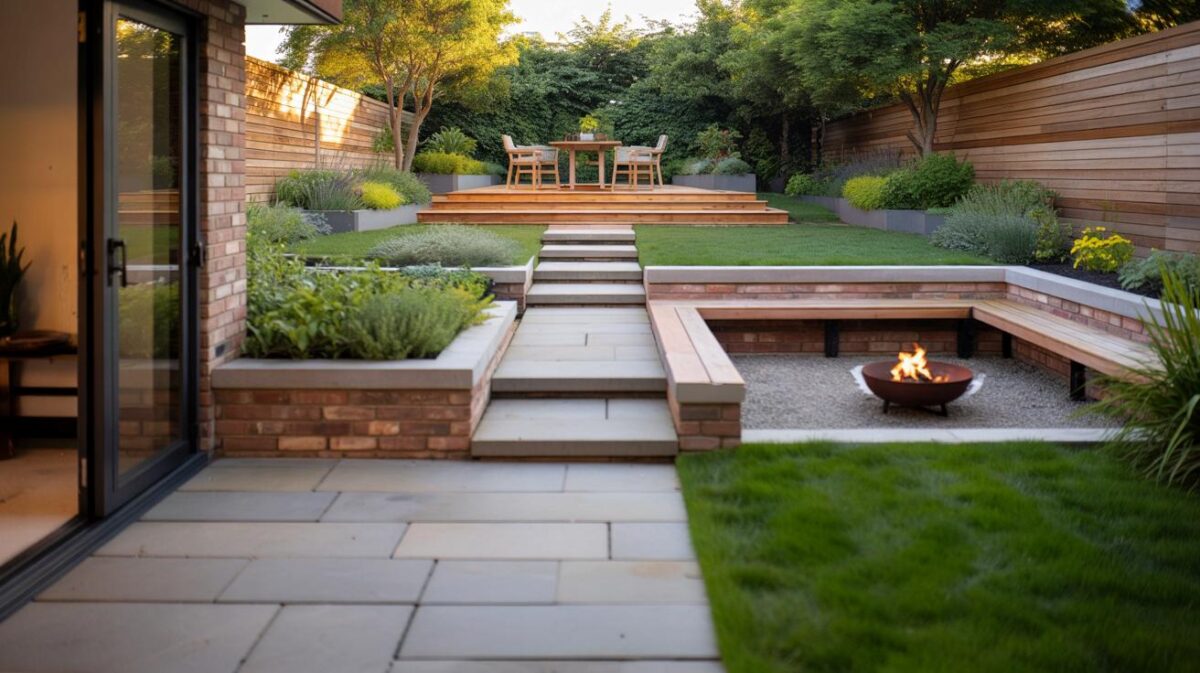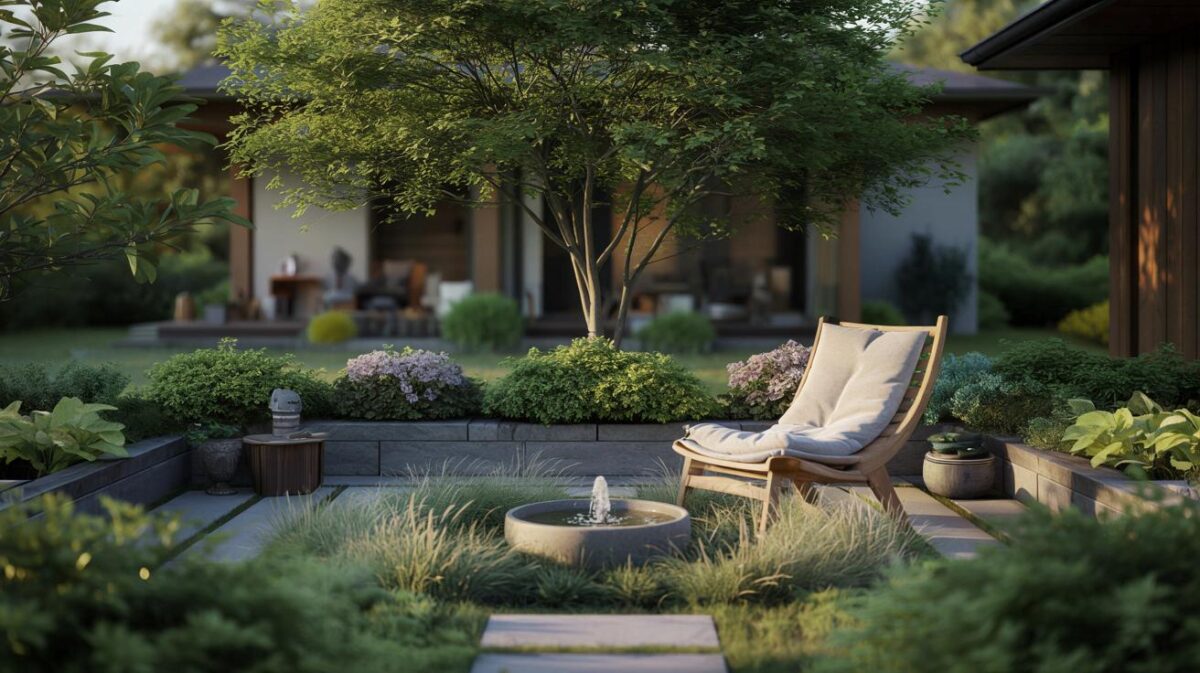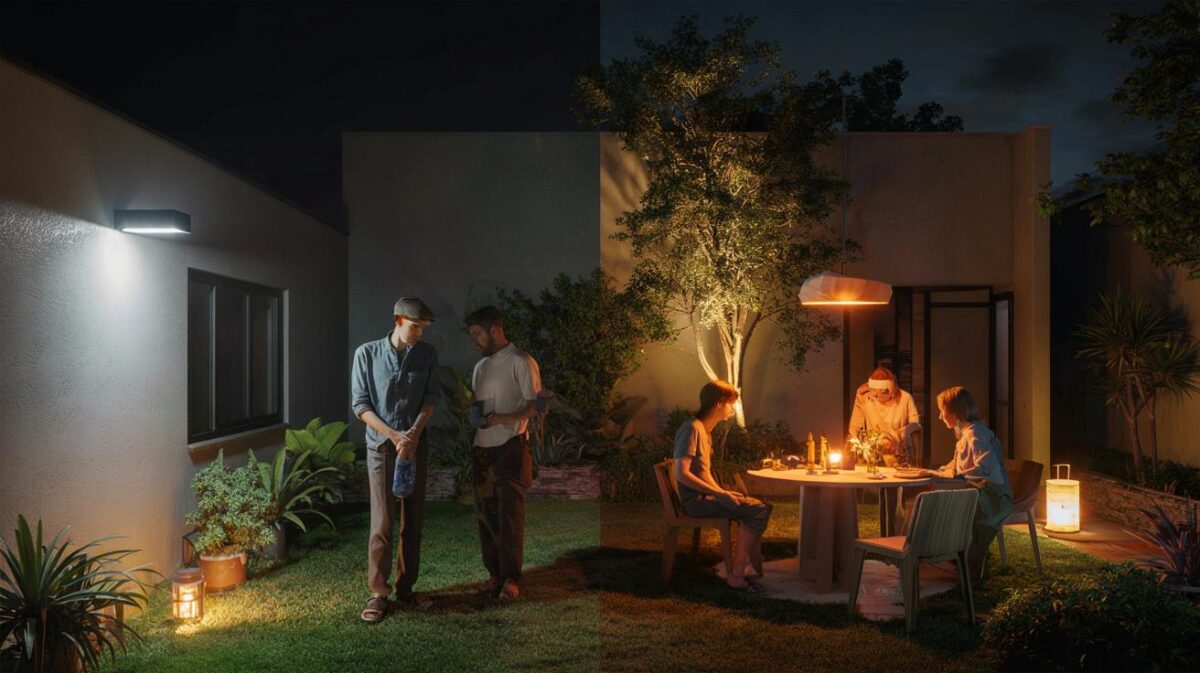
Late afternoon, low sun, and you’re standing in your yard with a coffee, silently judging your own outdoor space. The chairs are lined up like soldiers, the planters match, the lawn is clipped into obedient rectangles. Technically, everything looks “nice”. Yet for some reason, nobody ever lingers there. Friends drift back inside. You do too. The space feels… polite. And a bit dead.
Then you notice your neighbor’s garden. One crooked olive tree, a bench slightly off-center, a lantern hanging at a random height. The whole thing feels alive, like a place where stories happen. Your brain relaxes, your curiosity wakes up.
That’s the quiet power struggle between symmetry and asymmetry.
And it’s happening right under your feet.
Why symmetry soothes… and slowly bores you
The human brain loves symmetry. Two matching planters by the door. A perfectly centered fire pit. A table aligned with the patio tiles. It sends a silent message: “You’re safe here, nothing unexpected will jump out at you.” That’s why hotel gardens and public squares lean heavily on strict lines and mirrored layouts.
The problem is, an outdoor space that only reassures ends up feeling like a waiting room. Pretty, correct, instantly understandable. And instantly forgettable. Your eyes know the script before they even look around. No surprise, no tension, no little jolt of “oh, what’s that?”. Symmetry calms, but it rarely seduces.
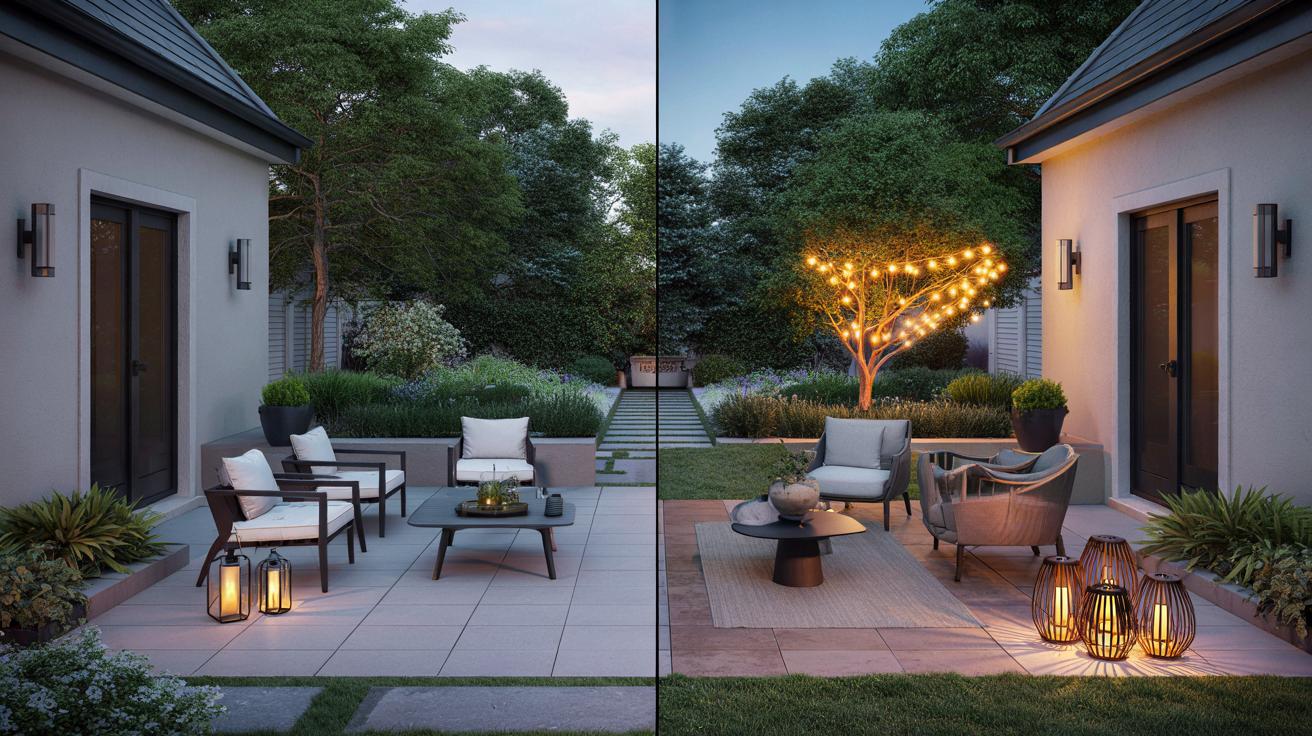
Picture two terraces side by side on the same street. On the left, four identical chairs, identical cushions, two matching lanterns framing a low table. Everything lined up with the French doors. It photographs well, you’d probably save it on Pinterest. You’d also scroll past in real life after five minutes.
On the right, a similar space. Same size, same budget. Yet there’s a single rocking chair facing slightly sideways, one oversized pot nudging the edge of the rug, a tree fairy-lit on just one side. Instantly, your body responds. You want to sit, turn your head, follow the line of the lights, tuck your feet under you. It’s the same square meters. Different emotional temperature.
Symmetry works because our brains are wired to spot patterns fast. It signals order and control, which is great near doors, paths, entry views. But a fully symmetrical garden is like a paragraph with perfect grammar and no adjectives. You’ll read it, you just won’t feel it.
As soon as you break the mirror, even gently, your brain has to do a tiny bit of work. It starts asking questions, tracing diagonals, following curves. That micro-effort is what we often confuse with “charm”. Too much, and the space feels chaotic. Too little, and it feels flat. The sweet spot lies in this subtle mix: symmetry as the frame, asymmetry as the spark.
How to use symmetry as your anchor, not your prison
Start by choosing one place where symmetry can do its job of reassuring: the entry, main path, or the view from your living room. Two pots by the door. Two lanterns flanking a step. A pair of armchairs facing each other across a low table. That’s your visual handshake.
Then stop there. Let the rest of the space loosen up. Once the “welcome” moment feels solid, you can let one path curve, pull a bench off-center, or place a tree slightly off the main axis. Symmetry becomes your anchor point, not a rule book carved in stone. You’ve given the brain its safety signal, so it can relax and accept a bit of play.
The most common trap is buying everything in pairs and sets. Four identical chairs. Six identical cushions. Three cloned shrubs in a straight line. It feels efficient and design-forward, until you realize your garden looks like a catalog page, not a place where people actually live. We’ve all been there, that moment when you unbox the fifth identical lantern and feel your soul go slightly beige.
A simple shift: think in families, not twins. Same color range, varied shapes. Same material, different heights. One large pot, one medium basket, one low stool used as a plant stand. The space still feels coherent, but the eye dances instead of marching.
“Symmetry is your handshake. Asymmetry is the wink you share afterwards.”
- Pick one axis of calm: Align your main seating or central path. Let this be the most “formal” part of the layout.
- Break the mirror gently: Offset a single piece of furniture. Shift one planter. Leave one side slightly heavier than the other.
- Repeat with variation: Same tone of wood, but different chairs. Same plant species, but in uneven clusters of 3 or 5.
- Keep one side a little wild: A looser planting bed, a cluster of mismatched lanterns, a tree not dead-center in the lawn.
- Test with your body: Sit, walk, turn around. If you feel like you’re in a showroom, add a little asymmetry. If you feel lost, bring back one clear symmetric cue.
The art of seductive imbalance outdoors
Seduction in an outdoor space doesn’t come from perfection. It comes from tension. From a bench that’s just slightly off the center line of a path. From a hammock slung between only one tree and a post, not framed like a stage. From a single bold plant stealing the spotlight in a sea of quiet greens.
A practical method: design one “almost-symmetric” scene, then remove or shift a single element. Two lanterns by the steps? Move one to the far corner of the terrace. Four matching dining chairs? Swap one for a slightly different chair at the head of the table. That small glitch in the pattern is what makes people look twice.
What quietly kills outdoor personality is not minimalism, it’s fear. Fear of doing it “wrong”. Fear of that one crooked pot your mother-in-law might notice. So people freeze into rigid layouts that feel correct on paper and stiff in real life. Let’s be honest: nobody really measures the exact distance between every chair and planter every single day.
A kinder approach is to play. Move one plant cluster a bit closer to where you actually sit. Angle the sofa toward the view you truly love, and not necessarily the exact center point. Try an outdoor rug that doesn’t align perfectly with the tiles. If it feels odd for two days and natural on day three, you’ve probably hit a good asymmetrical rhythm.
*Asymmetry is not mess; it’s intention with a human fingerprint left visible.*
- Use odd numbers: Plant in groups of 3 or 5. Cluster candles in 1–3–5 instead of 2–4. Odd numbers feel more organic.
- Create a “heavy” corner: A big plant, a tall lamp, or a sculpture that grounds one side of the space.
- Play with diagonals: Point a lounge chair toward the far corner, not straight at the wall. Hang string lights from one side to a distant anchor.
- Leave one imperfection on purpose: A mismatched chair, a slightly off-center table, a path that curves for no practical reason.
- Balance with repetition: Repeat one color or material in at least three different spots so the space feels intentional, not random.
Let your outdoor space flirt a little
Once you start seeing the dance between symmetry and asymmetry, it’s hard to unsee it. You notice that the courtyards you love always have some quiet order anchoring them: a centered doorway, a straight path, a pair of trees. Around that calm backbone, everything else loosens, tilts, spills, and surprises. It feels like stepping into someone’s personality, not a template.
Outdoors, you’re not just arranging objects, you’re shaping how people move, where conversations start, where someone might secretly curl up with a book. A space that only reassures will be used functionally. A space that also seduces will be lived in, remembered, talked about later in the car ride home. Symmetry can hold your hand, but asymmetry is what makes you stay a little longer than planned, just to see how the light hits that one crooked tree at sunset.
| Key point | Detail | Value for the reader |
|---|---|---|
| Use symmetry as an anchor | Frame entries, main views, or central seating in a calm, mirrored way | Gives instant visual order and a sense of safety |
| Break patterns with subtle asymmetry | Offset one element, work with odd numbers, create a “heavier” side | Adds charm, interest, and a lived-in feeling without chaos |
| Design for feelings, not perfection | Test layouts with your body, accept small imperfections, play over time | Transforms a bland yard into a personal, magnetic outdoor space |
FAQ:
- Question 1Is symmetry always bad in garden design?
- Answer 1No. Symmetry is powerful near entrances, main paths, and key views. It becomes a problem only when the whole space is rigidly mirrored with no softer, more playful areas.
- Question 2How do I know if my space is “too” symmetrical?
- Answer 2Stand back and squint. If both sides of your view look like copy-paste versions of each other, and your eyes don’t naturally travel around, you likely need one or two intentional asymmetrical elements.
- Question 3What’s an easy first step to add asymmetry?
- Answer 3Shift one key object off-center: the coffee table, a big plant, or a bench. Then balance that move with an echo of its color or material somewhere else in the space.
- Question 4Can a very small balcony handle asymmetry?
- Answer 4Yes. Use one main straight line (for example, the railing), then angle your chair slightly or choose one oversized plant on just one side to create a gentle visual imbalance.
- Question 5What if I’m afraid of the garden feeling messy?
- Answer 5Keep one clear structure—like a rectangular rug, a straight row of pavers, or a centered table—and limit yourself to two or three asymmetric gestures. Order stays, personality appears.