The first thing you notice isn’t the garden or the table or even the people. It’s the glare. That harsh, supermarket-white floodlight blasting from the side of the house, flattening every shadow and washing the whole yard in a sickly glow. You squint, balancing your plate, wondering why this cozy dinner suddenly feels like a staff car park behind a warehouse. The candles do nothing. The fairy lights lose the battle instantly. Everyone looks a little tired, a little older, a little overexposed.
Somewhere in the dark, a cricket chirps.
The mood that could have been magic is gone, and you feel it in your bones.
You tell yourself you’ll fix the lights “one day”.
That day starts with looking at the dark, not the bulbs.
Why bad outdoor lighting kills the mood
Outdoor light has a weird power: used wrong, it turns charm into concrete. You’ve probably walked into a yard where the lawn was lit up like a car dealership and felt your shoulders tense without knowing why. The faces are pale, the plants look plastic, and the night itself feels pushed away.
We think we’re making things “safe” and “practical”, yet what we’re really doing is erasing depth, mystery, even intimacy. A garden is supposed to blend with the night, not fight it. When the only lighting idea is “brighter must be better”, everything starts to look like a parking lot.
Picture two neighboring houses on a summer evening.
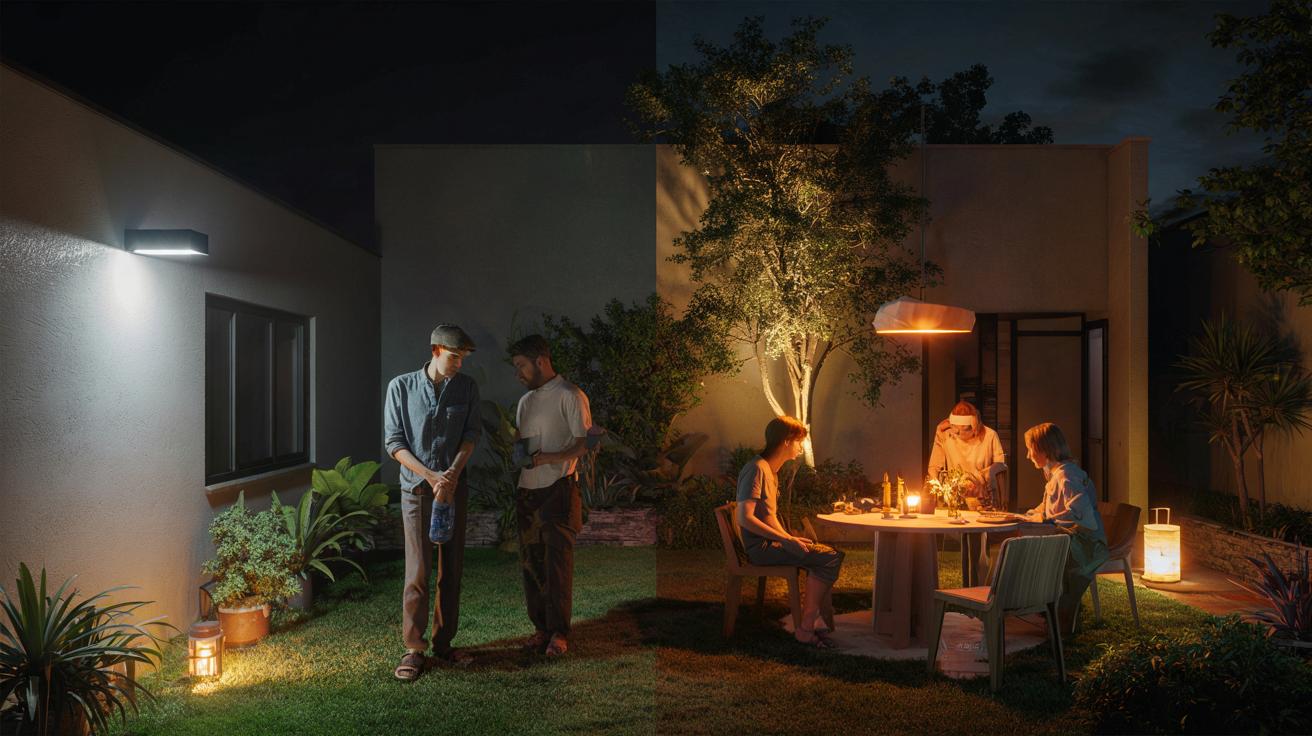
On one side: one brutal wall-mounted floodlight, motion sensor set to hypersensitive. Every time someone laughs or waves a hand, the beam explodes on, blinding the table, casting sharp shadows, freezing conversation for a split second. Kids cover their eyes, people joke about needing sunglasses, and no one lingers after dessert.
Next door, same size yard. Instead of one giant source, there are small pools of warm light: a soft glow on the table, tiny lamps low near the path, a discreet lantern near the door. Faces look warm, the night stays dark beyond the fence, and people lean in instead of leaning back.
The difference isn’t money or square meters. It’s intention. Floodlighting tries to dominate the entire space at once, which instantly flattens everything into one single visual layer. Our brains get bored and our bodies feel exposed.
Small, layered lights give the eye something to explore: a lit leaf, a soft highlight on stone, a gentle halo on the table. That contrast between light and shadow is what creates drama. We’re wired to respond to it. When you erase the shadows, you erase the story.
How to create drama without turning your yard into a parking lot
Start by killing the main culprit: the all-powerful wall floodlight. Don’t rip it off the wall yet, just stop letting it be the star. Change the bulb to a lower wattage, pick a warmer tone, and dial back the motion sensor so it doesn’t trigger every time a moth changes its mind.
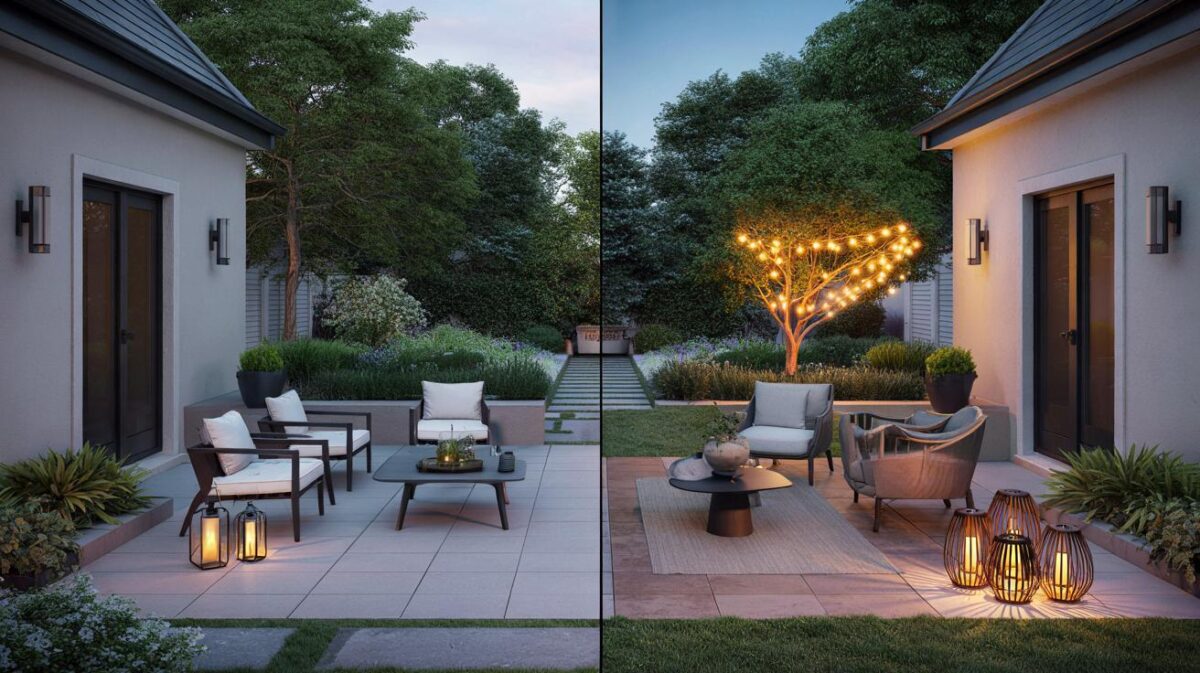
Then think in “islands” instead of “stadiums”. Light the table as its own little scene, with a pendant, a portable lamp or a cluster of candles. Light the path separately, low and discreet. Highlight one tree, or one wall, or one cluster of plants. When each island of light floats in a sea of darkness, your yard suddenly feels deeper, larger, and much more cinematic.
A common mistake is lighting the ground like a runway and forgetting the verticals. Those bright little spots on the floor can be useful, but they don’t flatter anyone’s face and they don’t create atmosphere on their own. Try lifting the light: a lantern on a low table, a lamp clipped to a pergola beam, string lights that hang, not stretch in tense straight lines.
Another trap is going cold and white “for visibility”. You’ll see every crumb, yes, but you’ll also see every under-eye circle and every spiderweb. Go for warm tones, around 2200–2700K, that soft almost-amber glow. Your yard will instantly shift from “security zone” to “evening scene”.
We’ve all been there, that moment when you step outside and realize your own garden feels more like a car park than a place to breathe.
- Use three light levels
Low lights for paths and borders, medium for faces and tables, one or two higher accents for trees or walls. - Hide the source, show the effect
Tuck fixtures behind pots, under benches, in foliage, so you see the glow, not the bulb. - Think scenes, not systems
One setup for dinner, another for late drinks, another for quiet solo evenings. You don’t need them all on every night. - *Let’s be honest: nobody really adjusts every single light every single night.*
So create two or three simple presets you can switch on without thinking.
Let the night do half the work
The most beautiful outdoor lighting always respects the dark. You don’t need to erase the night to feel safe, and you definitely don’t need to blast every corner to enjoy your space. Once you start treating darkness as a design material, not a problem, your whole approach shifts.
You begin to ask softer questions: What do I actually want to see? Where do I want the eye to rest? Which corner can stay in shadow and hold its own mystery? That’s where drama lives, not in the lumen count.
The truth is, the most memorable evenings outside usually happen under lights that are a little too dim on camera, but perfect for conversation in real life.
| Key point | Detail | Value for the reader |
|---|---|---|
| Think in islands of light | Create separate zones: table, path, feature, entry | Transforms a flat, overlit yard into a layered, atmospheric space |
| Use warmer, lower-intensity bulbs | Aim for 2200–2700K and smaller sources instead of big floods | Makes faces look better and the garden feel welcoming, not clinical |
| Let shadows stay | Highlight a few elements and leave others in darkness | Adds drama, depth and that quiet feeling you actually want at night |
FAQ:
- How many outdoor lights do I really need?Less than you think. Start with three: one for the table, one for the path or steps, one accent on a tree, wall, or plant group. Add only if a specific area still feels unsafe or unused.
- What color temperature works best for a cozy garden?Warm white between 2200K and 2700K. It’s close to candlelight, flatters skin tones, and blends naturally with the night sky instead of fighting it.
- Are solar lights enough to create atmosphere?They can help, especially for paths and soft accents, but they’re rarely strong or consistent enough to be your main source. Use them as seasoning, not the main dish.
- Should I leave some lights on all night for security?A small, low-level light near entry points can be useful. Avoid leaving bright floods on; they disturb sleep, neighbors, and wildlife while not actually making you much safer.
- How do I avoid that “parking lot” feeling on a small terrace?Skip ceiling floods. Use table lamps, wall sconces with warm bulbs, and one gentle string of lights. Light objects close to you, not the farthest corners of the space.