At 7:13 p.m., you close the laptop, step into the garden, and feel… nothing.
No wave of relief. No deep breath that suddenly becomes easier. Just the same buzzing thoughts, now framed by a patch of grass, a few pots and a tired plastic chair.
You sit down, phone still in hand, scrolling out of habit. The birds are singing, the light is beautiful, but your shoulders stay tense. The space is technically “nice”. People even compliment it. Yet your brain refuses to switch off.
That disconnect is not in your head.
It’s in the garden.
If your garden doesn’t calm you, it’s badly designed
There’s a brutal idea that professional landscapers whisper sooner or later: **a beautiful garden isn’t always a soothing garden**.
Many outdoor spaces are Pinterest-pretty and mentally exhausting at the same time.
Too many colors, too many pots, furniture facing the wrong way, the constant reminder of chores waiting to be done. Your eyes jump from detail to detail, and your nervous system never finds a landing strip.
The place that should hold you ends up nagging you.
A genuinely calming garden feels like a hand on your shoulder.
Not fireworks in your field of vision.
Picture this.
A couple outside Lyon had done “everything right”: immaculate lawn, clipped boxwood balls, a designer dining set, gravel paths. Friends loved coming for barbecues.
Yet the owner admitted she avoided the garden when she was stressed.
She’d sit on the staircase by the back door instead, coffee in hand, staring at nothing. One day a landscaper visited and asked her to stand in different spots and rate, from 1 to 10, how relaxed she felt. The highest score wasn’t by the dining area, or the manicured lawn. It was in a narrow corner, where a single small tree and a rough wooden bench cast dappled shade on cracked tiles.
That messy little corner, not the showpiece, was the true refuge.
The design just hadn’t listened to her body yet.
Our brain reads a garden exactly like a room.
It scans for edges, directions, exits, and tasks. A large empty lawn feels exposed. A maze of tiny beds feels chaotic. A row of tools in sight shouts “work to do”.
When the layout doesn’t provide a clear place to land, the mind keeps searching. That’s where anxiety thrives.
What calms us is the opposite: legible spaces, a sense of gentle enclosure, a focal point that says, “Look here, not everywhere.”
It isn’t about having more plants or fancier furniture.
It’s about orchestrating silence for the eyes, and safety for the nervous system.
Small design shifts that turn a yard into a refuge
Start with one radical question: where does your body naturally want to sit?
Forget symmetry, forget where the terrace already is. Walk around slowly, at different times of day, and notice spots where your shoulders drop just a little.
That might be under a tree facing the sky.
Against a wall that blocks the wind. At the end of a path where you don’t feel stared at from the house or the street. Mark that place with a stone, a chair, anything. That is your anchor point.
From there, arrange the rest so that everything gently leads toward that anchor.
Paths, pots, lights, even how you angle a chair — all of it should serve that quiet center.
Most people think “more plants” will solve the problem.
They buy roses, hydrangeas, grasses, then spend weekends moving pots like furniture. The result is often a plant showroom, not a sanctuary.
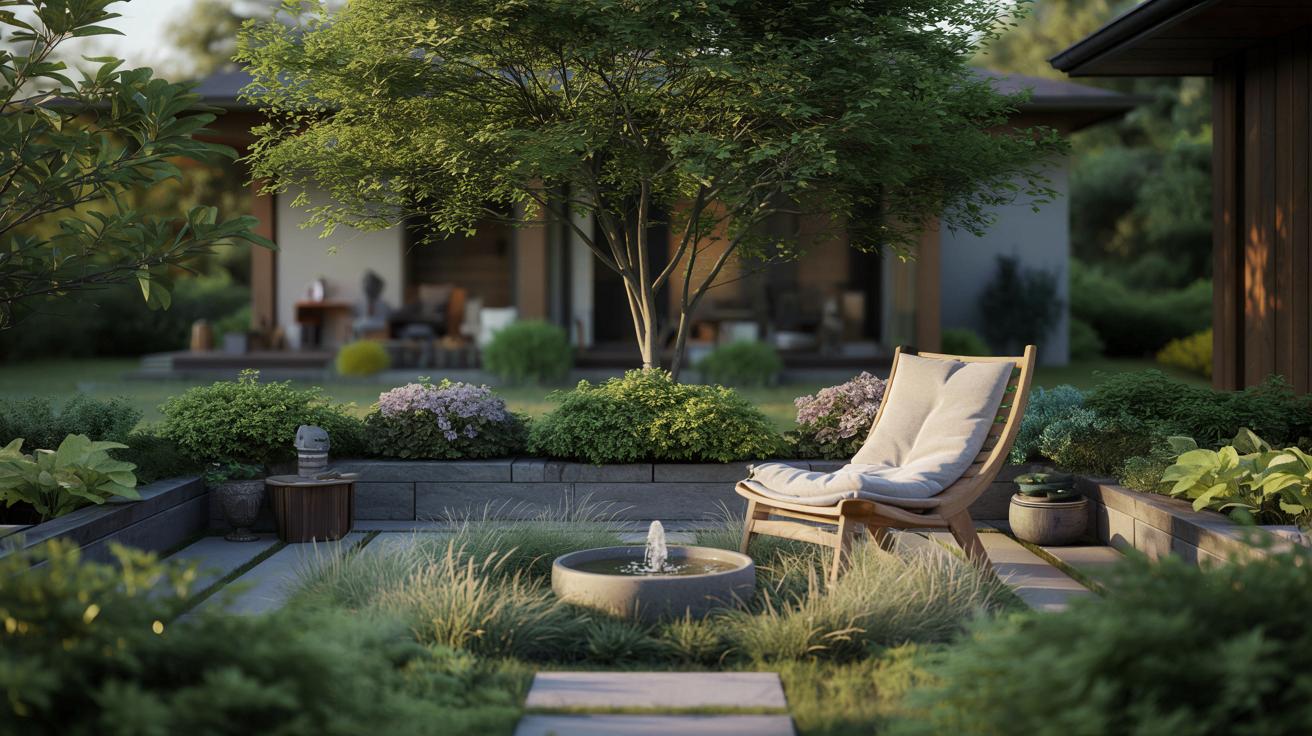
A calmer approach: choose one main soothing view from your favorite seat.
Maybe it’s a small tree, a large pot with a single grass, or a fountain. Then simplify everything in that line of sight. Reduce colors. Group similar plants instead of scattering them. Hide the bins, tools and compost behind a screen or shrub line.
Let’s be honest: nobody really deadheads, weeds and tidies every single day.
If the garden only looks peaceful after three hours of maintenance, your brain will never fully rest in it.
Sometimes the most powerful garden redesign isn’t an extension or a pergola.
It’s turning one chair 30 degrees and saying, “This is my spot now.”
- Create one “no-task view” from your main seat: nothing visible there should scream chores.
- Use low, wrapping elements (shrubs, planters, even a low wall) to create a feeling of gentle enclosure around that seat.
- Limit your palette: 2–3 main foliage tones, 2 main bloom colors, repeated.
- Introduce a soft sound — a water feature, rustling grasses, wind chimes that aren’t too bright or sharp.
- Keep access to the refuge easy: one simple path, clear by day and softly lit by night.
The emotional architecture of a peaceful garden
Beneath the plants and chairs, a calming garden hides a quiet emotional blueprint.
There’s always a threshold where you feel you’re “entering” another mood. It might be a step down, a gate, two pots flanking a path, even a shift in ground texture.
That micro-ritual matters. It signals to the brain: different rules apply here.
Noise and speed stay outside. Inside, movement slows, voices soften, phones feel out of place. *A well-designed outdoor refuge behaves like a tiny temple without calling itself one.*
You don’t need a big budget for that.
You need intention in three key layers: what you see, what you hear, and where your body can quietly lean.
| Key point | Detail | Value for the reader |
|---|---|---|
| Anchor a true refuge spot | Identify and design around the place where your body feels safest and most relaxed | Instantly increases the calming effect of the whole garden |
| Simplify the visual field | Reduce visible chores and visual noise in your main line of sight | Helps the brain switch from “to-do mode” to rest mode |
| Create a sensory ritual | Use thresholds, soft sounds and gentle enclosure to signal “you’re entering a different space” | Transforms everyday steps outside into a micro-reset for the nervous system |
FAQ:
- How do I know if my garden is stressing me out?You step outside and instantly notice tasks: weeds, tools, dirty furniture, toys everywhere. Your eyes keep scanning instead of resting on one soothing view, and you often feel pulled back inside rather than tempted to linger.
- Can a tiny balcony really become a mental refuge?Yes. Focus on one comfortable seat, a small sense of enclosure (screen, railing planter, fabric), a single beautiful focal point, and one soft sound or texture. Think “mini-cocoon”, not “mini-garden show”.
- What’s the quickest change with the biggest impact?Reorient your main chair and declutter its view. Remove or hide anything that looks like a chore. Add one strong focal point — a pot, lantern, or plant — to give your eyes a calm place to land.
- Do I need a landscaper to redesign my space?Not necessarily. A pro helps with structure and planting, but you can test new layouts with temporary items: move chairs, group pots, hang a sheet as a fake screen. Live with it a week, then adjust.
- What if my family uses the garden mainly for play and noise?Zone the space. Keep an area dedicated to activity and another, even very small, zone protected as the “quiet corner”. Clear visual boundaries help everyone respect both types of use.